Does Mewing really work?
You've seen it on TikTok or YouTube: someone presses their tongue against the roof of their mouth, holds it there, and claims that months later their jawline is more defined and their profile has changed.
The honest answer right off the bat: if you're old enough to read this article, mewing isn't going to reshape your face.
But the idea behind it isn't nonsense. It's a repackaged version of something that dentistry and speech therapy have understood for decades—and the real thing can do a great deal for a growing child. There are effective options for adults, too. They just aren't the ones going viral.
What is mewing?
Mewing is named after the late British dentist John Mew, who developed a method he called "orthotropics," and his son Mike Mew. Both have since been removed from the UK dental register—which is worth noting, given how much of the online enthusiasm relies on their authority.
The technique is simple: rest your tongue flat and wide against the roof of your mouth—the entire tongue, including the back third—keep your lips sealed, let your teeth rest lightly together, and breathe through your nose.
The key point is that it is meant to be a resting position, not an exercise. Not ten minutes a day, but all day long, until it becomes your tongue’s natural position.
What are people hoping to get out of it?
Two quite different sets of hopes:
Appearance. A sharper jawline, higher cheekbones, a more prominent midface, less soft tissue under the chin, and straighter teeth without braces. In the "looksmaxxing" corners of the internet, mewing is marketed as free at-home facial surgery.
Health and function. Easier nasal breathing, less snoring, better sleep, relief from a dry mouth and constant congestion. Some people discover mewing while searching for answers about sleep apnea.
Both are reasonable goals, and both point to something real: the shape of your jaws genuinely does affect your appearance and how well you breathe. The question is whether a specific tongue posture can achieve that.
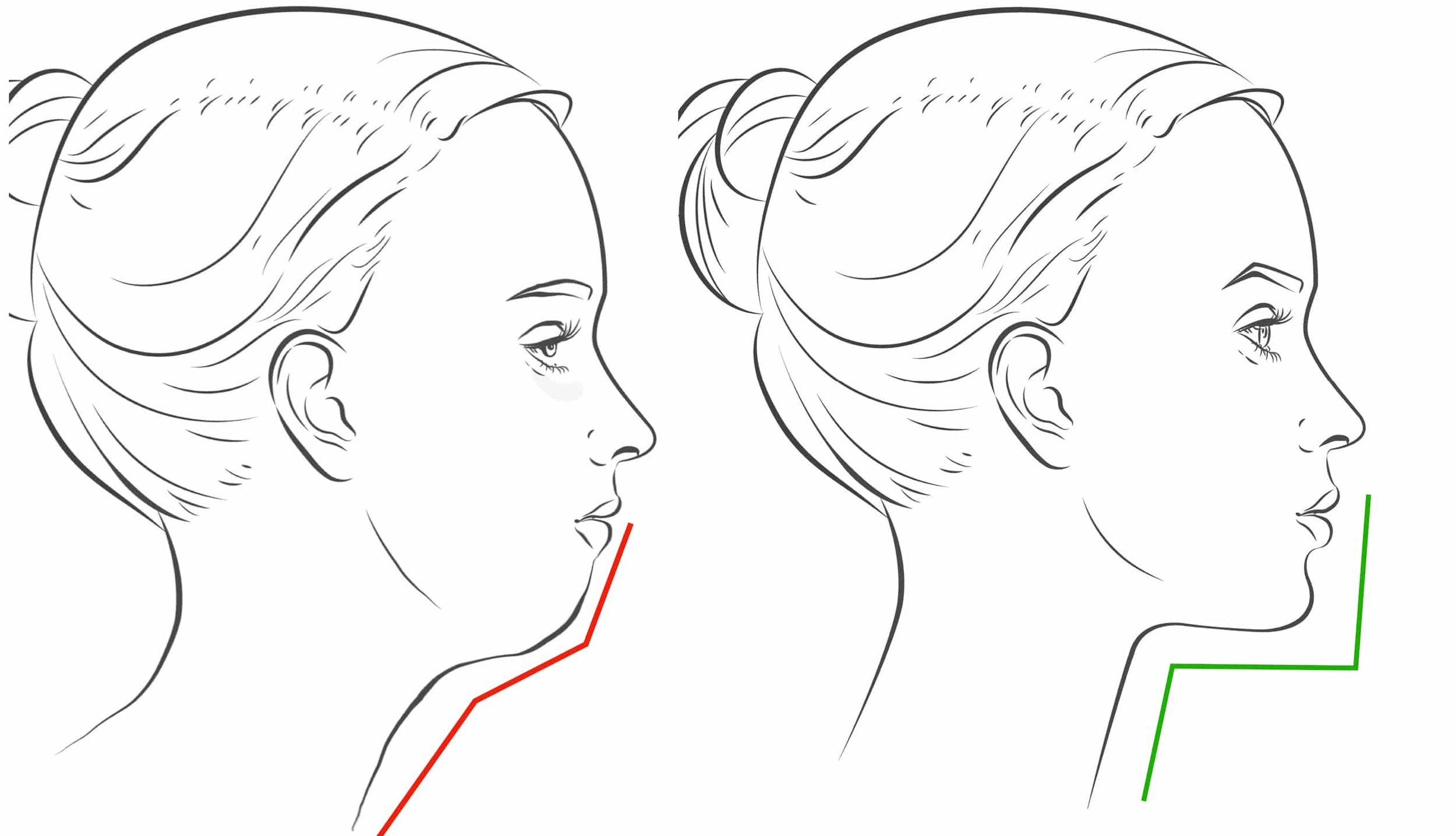
Left: Poor facial development resulting from mouth breathing and incorrect tongue posture.
Right: Proper facial development, nasal breathing, and the tongue resting on the palate.
Mewing already had a name: myofunctional therapy
Here is what the videos don't mention. Mewing is just one element of orofacial myofunctional therapy.
Myofunctional therapy is the structured retraining of the muscles of the face, mouth, and throat. A course of therapy focuses on:
Tongue resting position — pressed against the roof of the mouth, not resting low on the floor of the mouth
Nasal breathing —day and night—instead of habitual mouth breathing
Swallowing — without the tongue pushing forward against the teeth
Lip seal — lips closed at rest, without tension
Chewing —properly, using the back teeth, on both sides
It is provided by a trained therapist. It begins with an assessment, involves developing a personalized plan that spans weeks to months, and verifies that the prerequisites for success are in place before it begins.
So—does it work?
Split it into two questions, because the answers are different.
Does the tongue play a role in how a face develops? Yes.
Can the tongue change a face that has finished growing? No.
To make a long story short: if you're an adult, mewing won't significantly change your bone structure. An article by the American Association of Orthodontists puts it succinctly: the evidence supporting mewing's claims to sculpt the jawline is "as thin as dental floss." Facial structure results from the interaction of genetics, skeletal growth, and muscle function over many years—not from tongue placement in adulthood.
You might be surprised, but sustained, uneven pressure from the tongue can move some teeth but not others, creating gaps or causing teeth to tilt out of alignment. It can alter your bite and has been linked to jaw joint pain and speech difficulties. If it does cause damage, correcting it takes longer than the original treatment would have.
What Actually Helps the Jaws Develop
While a face is still developing, function is a genuine factor. Four things matter most.
Breastfeeding. Breastfeeding requires more effort from the tongue and jaw than bottle-feeding. Longer breastfeeding is associated with significantly less posterior crossbite and fewer cases of crowded, narrow upper arches. Note: These are observational studies rather than proof.
Hard, fibrous food—actually chewed. Bones are built by resistance. Based on animal studies and comparisons across populations and historical periods, there is good reason to believe that a soft, processed diet provides the growing jaw with far less resistance to work against. Raw vegetables, whole fruit, coarse bread, meat on the bone: that is training.
Correct tongue resting posture. A tongue resting against the roof of the mouth acts as a gentle internal support structure throughout the day. This is the core principle on which mewing is based—in children.
Nasal breathing. Arguably the most important, because it influences the others. A child who breathes through the mouth must keep it open; when the mouth is open, the tongue drops away from the palate and the lips cannot seal. Over the years, this pattern is associated with a narrow upper jaw, a longer face, and a mandible that sits lower and further back.
All four are about function —what the mouth is required to do while it is developing.
The principle: form follows function
Bone is not an inert scaffold. It is living tissue that remodels in response to the forces acting on it—the principle behind Wolff’s law, and the reason astronauts lose bone density and tennis players build it asymmetrically in their playing arm. In the face, the corresponding idea is the “functional matrix” hypothesis: how the soft tissues function influences how the bones grow. It is a well-supported principle rather than a precisely quantified law, but the direction is clear.
A palate with the tongue resting on it, air moving quietly through the nose, lips sealed, and back teeth chewing real food tends to grow wide and forward. A palate with the tongue low, the mouth hanging open, and nothing to chew tends to grow narrow and downward.
This is why myofunctional therapy has real potential in children and so little in adults. In a child, you aren't forcing the bone in any particular direction—you're changing the guidelines according to which it grows.
But the principle works both ways, and this is the caveat that’s often overlooked: form also constrains function. If a child’s palate is already too narrow for the tongue to fit into, the child cannot adopt the correct posture, no matter how motivated they are. If the nasal airway is blocked—due to adenoids, tonsils, allergies, or a deviated septum—they cannot breathe through the nose, and the mouth will be used instead. Every single time. That is why you cannot simply assign exercises and hope for the best.
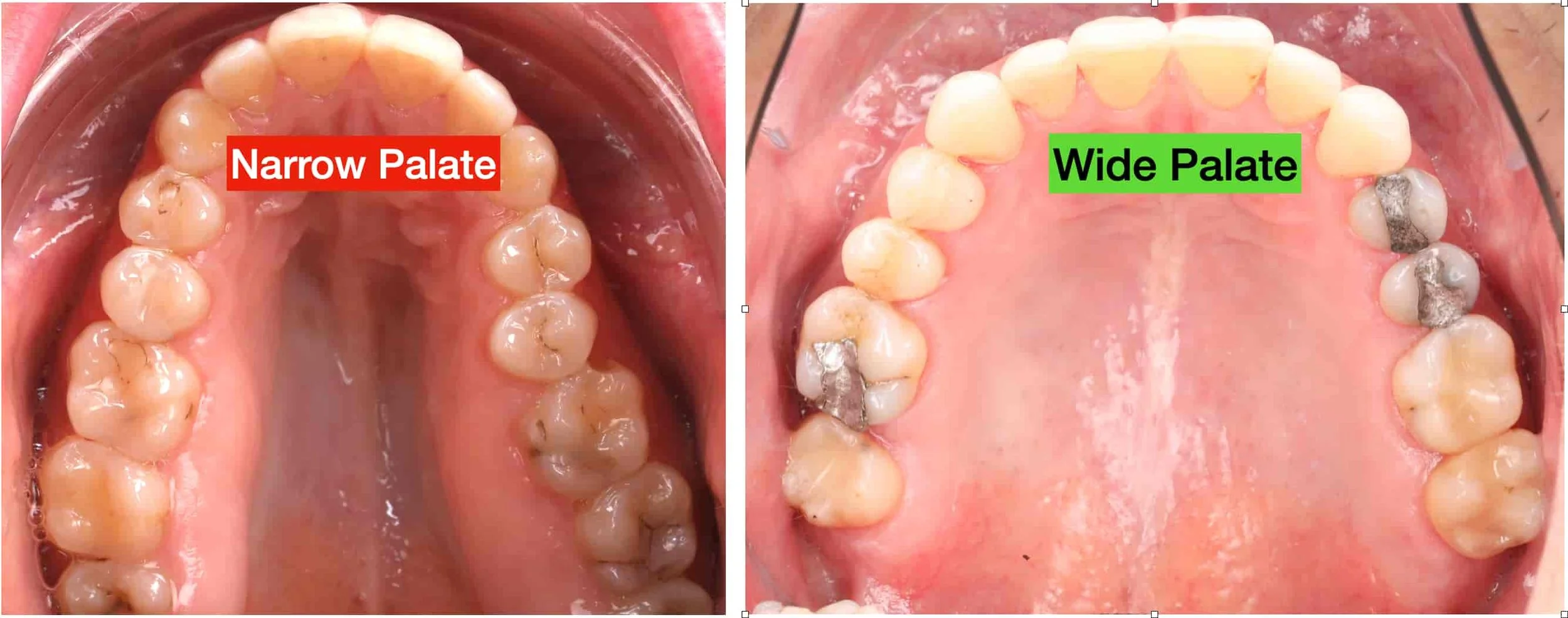
Left side: narrow palate, no space for the tongue; right side: wide palate and sufficient space for the tongue.
How long do jaws grow?
This determines which treatment is possible, so it's important to be precise.
The upper jaw (maxilla) By around age 12, much of the maxilla’s transverse development—and a substantial proportion of its overall size—is complete, but length and vertical growth may continue throughout the teenage years.
The lower jaw (mandible) continues to grow longer—generally into the mid-to-late teens for girls and the late teens to early twenties for boys, with considerable variation.
So: the window of opportunity during which the jaws can be shaped by function or moved using simple appliances is childhood and early adolescence. As long as the jaws are growing, you can influence their shape. Once growth is complete, you can no longer do so through function alone.
That is the real reason why mewing doesn't work for adults. It's not that the tongue isn't important—it's just that the tissue is no longer malleable.
What treatments are available?
Young children, ideally ages 2–6: myofunctional therapy
The best window there is. Establish nasal breathing, a lip seal, an elevated tongue, proper chewing, and correct swallowing—and then let growth do the work. Early, non-invasive—working with biology rather than against it. The very earliest part of that window really comes down to habit and airway management (ENT and allergy treatment, weaning off the pacifier or thumb-sucking).
Two prerequisites, both of which are non-negotiable:
The child must be able to breathe through the nose. If the nose is blocked, mouth breathing always takes over. An ENT evaluation is often the first step.
There must be enough space on the palate for the tongue. If the upper arch is too narrow, the tongue has nowhere to go.
If either is missing, that is addressed first.
From around age 4 through the early teens: guiding growth with orthodontic appliances
When the palate is too narrow for the tongue, or the nasal airway is obstructed by a narrow upper jaw, an expander widens it. Because the suture is still open, this results in actual skeletal change rather than just tooth movement. Conventional tooth-borne expanders become progressively less reliable from the early to mid-teens—which is exactly why the adult techniques described below exist.
In this case, the appliance and therapy go hand in hand: the expander creates the space, and therapy teaches the tongue to move into it and hold it there. Form, then function.
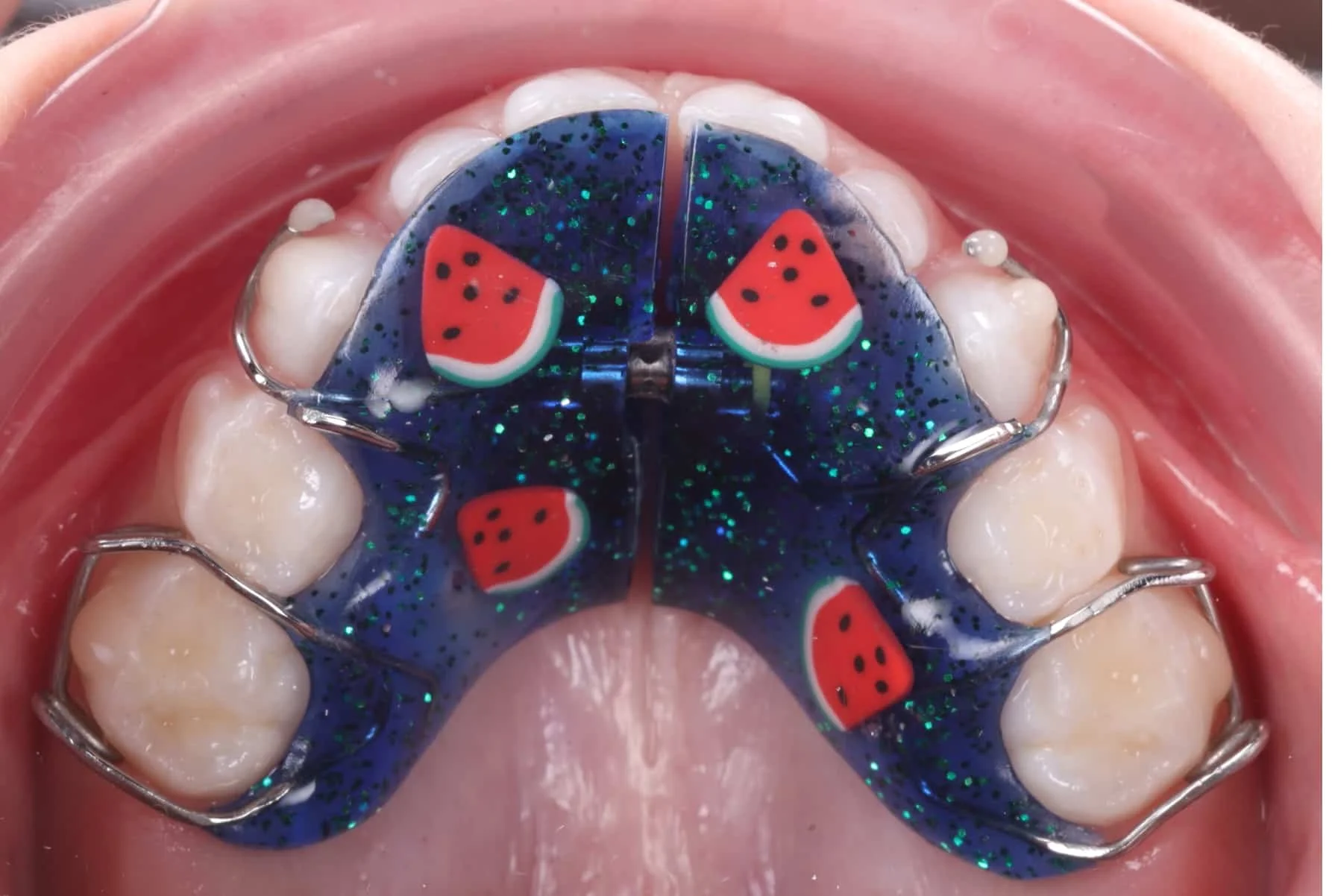
Expander in a 4-year-old patient
Adults: Orthopedic Expansion with DOMEzero
If you're reading this, you're most likely already an adult, and you'd probably prefer to have a larger jaw rather than a smaller one. Tongue posture can't give you that. Skeletal expansion can.
DOME stands for Distraction Osteogenesis Maxillary Expansion; DOMEzero is the version that incorporates synchronized clear aligners to prevent a gap from forming between the front teeth. It specifically addresses the problem described above: in adults, the midpalatal suture will not reliably open simply by applying pressure to the teeth.
So instead of applying pressure to the teeth and hoping for the best, the DOMEzero expander is anchored directly into the bone of the palate using mini-implants and activated gradually, in small increments. The bone edges separate, and the body forms new bone in the space created. (Fun fact: distraction osteogenesis—the same principle used in limb-lengthening surgery.)
The "zero" refers to the gap. Conventional adult expansion involves a wide space between the upper front teeth for months. With DOMEzero, clear aligners are worn simultaneously, moving the teeth into the new bone as it forms, so that no gap ever opens.
What can change:
A different palate — real space for the tongue
A wider nasal floor and larger nasal airway — easier nasal breathing, and for many patients, better sleep and less snoring
A wider smile arch —a structural change to the upper jaw, not a cosmetic illusion superimposed on it
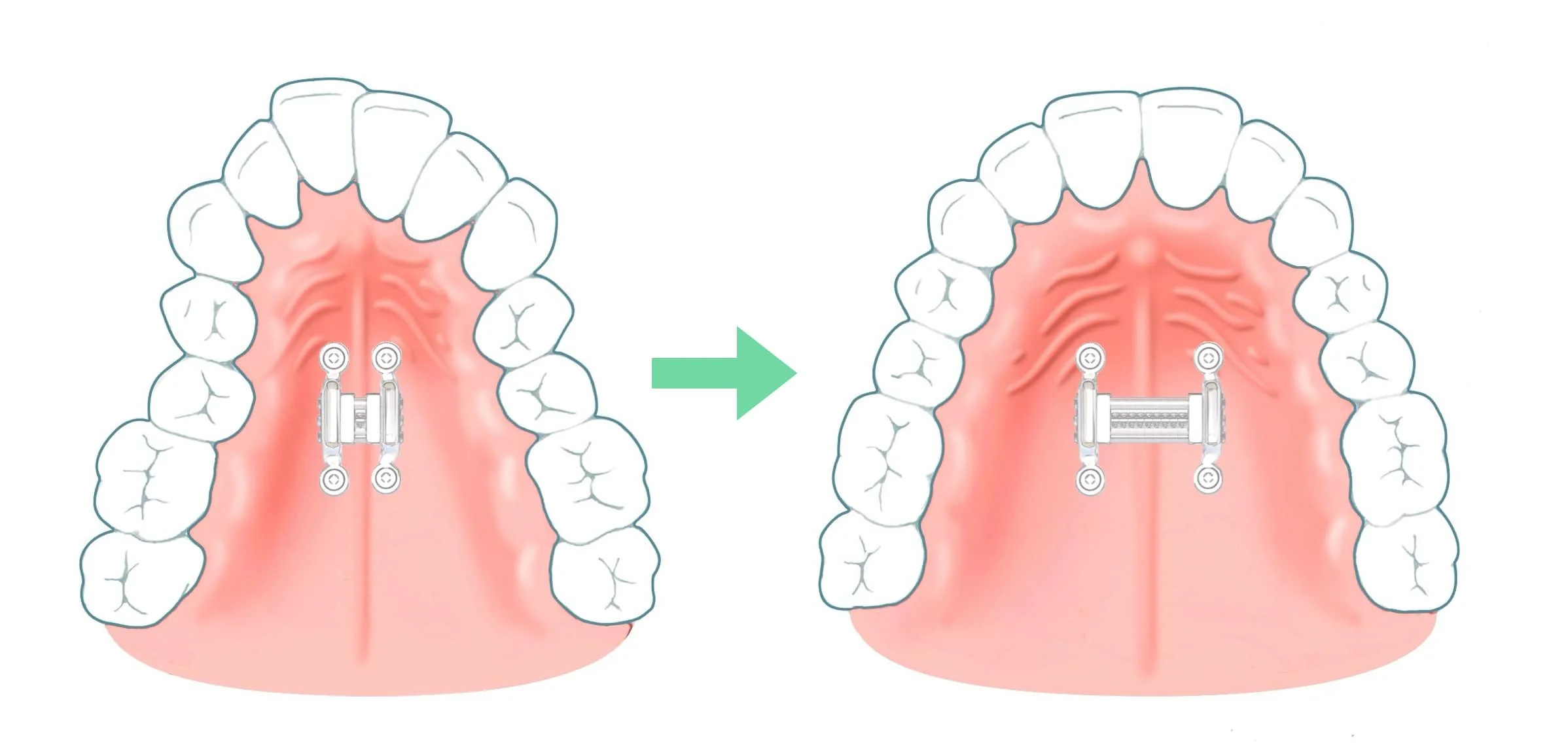
DOMEzero illustration: jaw growth in adults
What you should also know. DOMEzero is designed to work without bone cuts whenever possible, and in most adults it does—but sometimes the bone resists separation, and a (minimally invasive) surgical release is needed; this cannot always be predicted in advance based on imaging.
If snoring or daytime fatigue are among the reasons you are here, that suggests you should undergo a sleep study and receive a medical diagnosis. Expansion can significantly improve the airway, and the published evidence comes from adults diagnosed with obstructive sleep apnea. However, it is not a standalone cure and should not be started based on suspicion alone (!!).
Timeline (how we do it; other practices follow a different sequence). Active expansion typically takes 4–8 months—a deliberately slow process because the movement of the aligners is synchronized with it. The appliance then remains in place for another 9–12 months while the new bone mineralizes. Including bite adjustment, total treatment takes about two years on average. This is a true orthopedic treatment—not a quick fix—but it changes the skeleton, something no other treatment here can do in an adult.
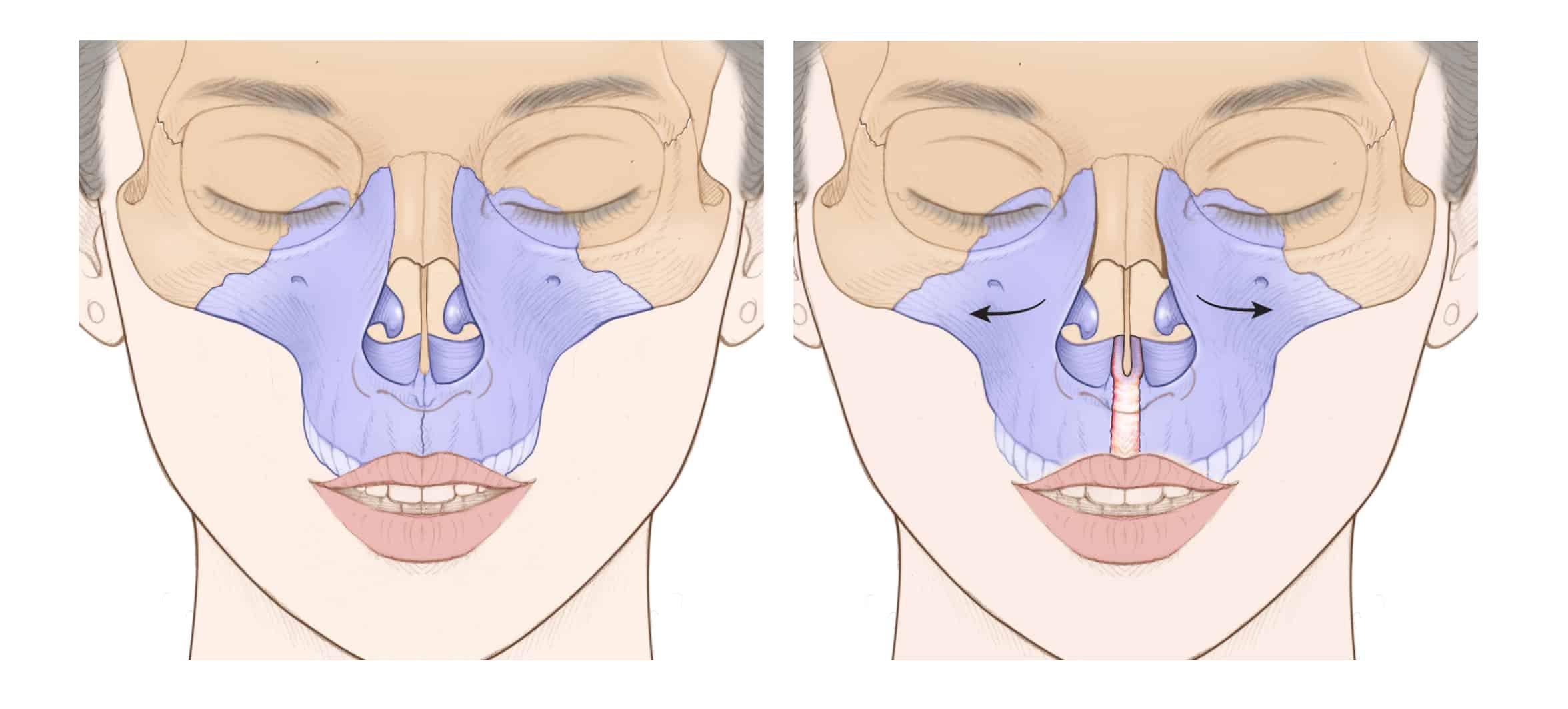
DOMEzero effects on the nasal cavity (wider nasal floor) and smile (wider smile).
And then the function has to follow
With DOMEzero, we create the right form. Now we want function to follow it.
That is why I strongly recommend that adult orthodontic patients also work with a myofunctional therapist. Therapy retrains the resting posture, establishes nasal breathing and a lip seal, and corrects swallowing. That retraining is what ensures the stability of the result rather than allowing it to revert.
The entire argument of this article in two sentences: In a child, function shapes form. In an adult, we create the form—and function is what holds it together.
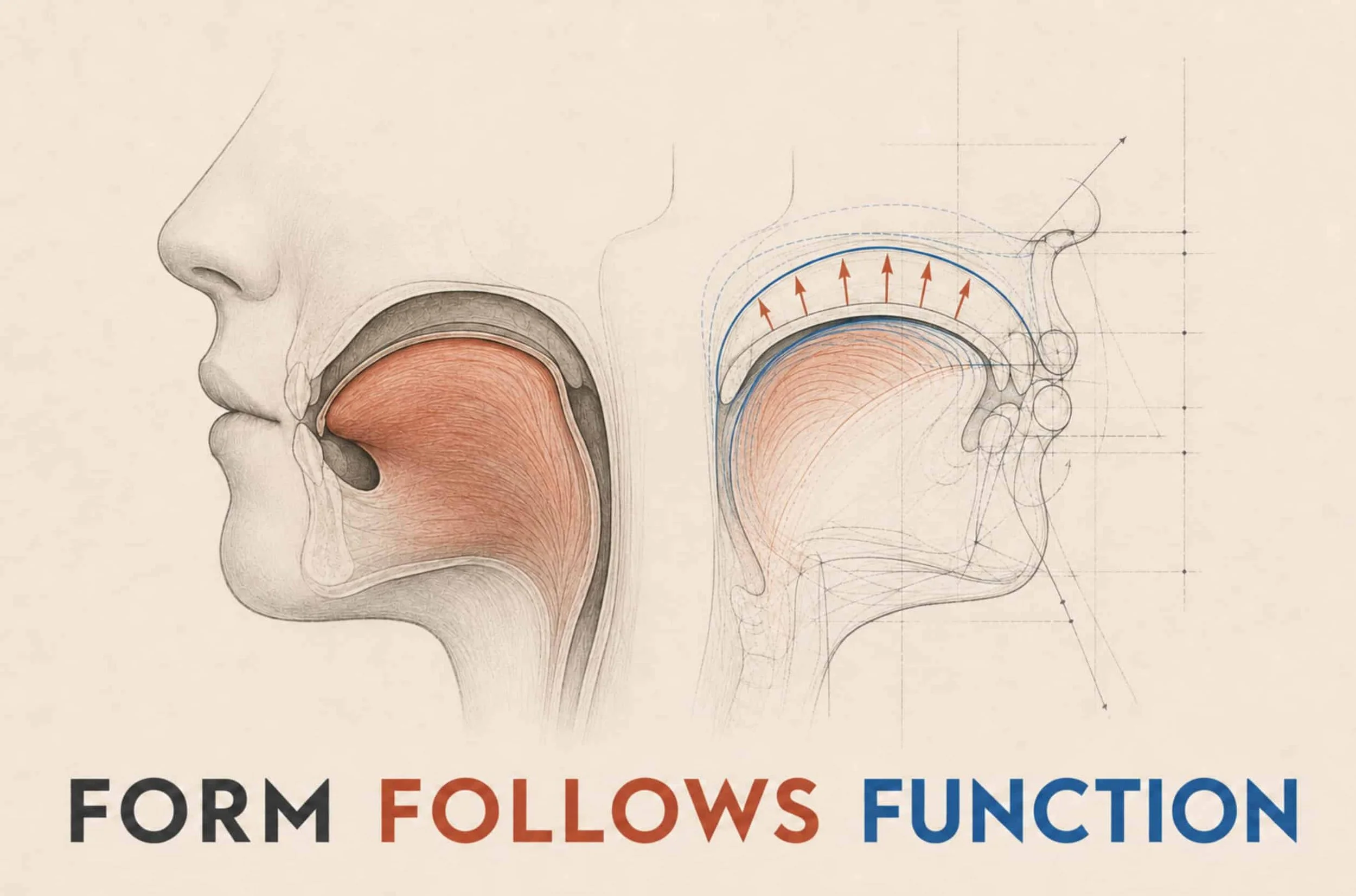
In early childhood, the tongue shapes the palate.
So, does mewing really work?
As a quick fix for a defined jawline: no. If your face has stopped growing, no amount of pressure from your tongue will change your bone structure, and doing it without supervision risks moving your teeth in ways you didn't intend.
As a rediscovery of a truth about how faces develop: absolutely. Tongue position, nasal breathing, and proper chewing are incredibly important—during growth. The problem with mewing isn't the idea itself; it's the timing.
If you're an adult who recognizes yourself in this description —a narrow palate, crowded teeth, no room for your tongue, a stuffy nose, snoring, waking up tired—the best next step isn't another tongue exercise. It's finding out whether your upper jaw can still be expanded, and what that would entail for you.
That's what a consultation is for. We examine your airway, palate, bite, and imaging results, and give you a straightforward answer about whether DOMEzero is right for you—including what it can't change and whether another option might be a better fit for you.
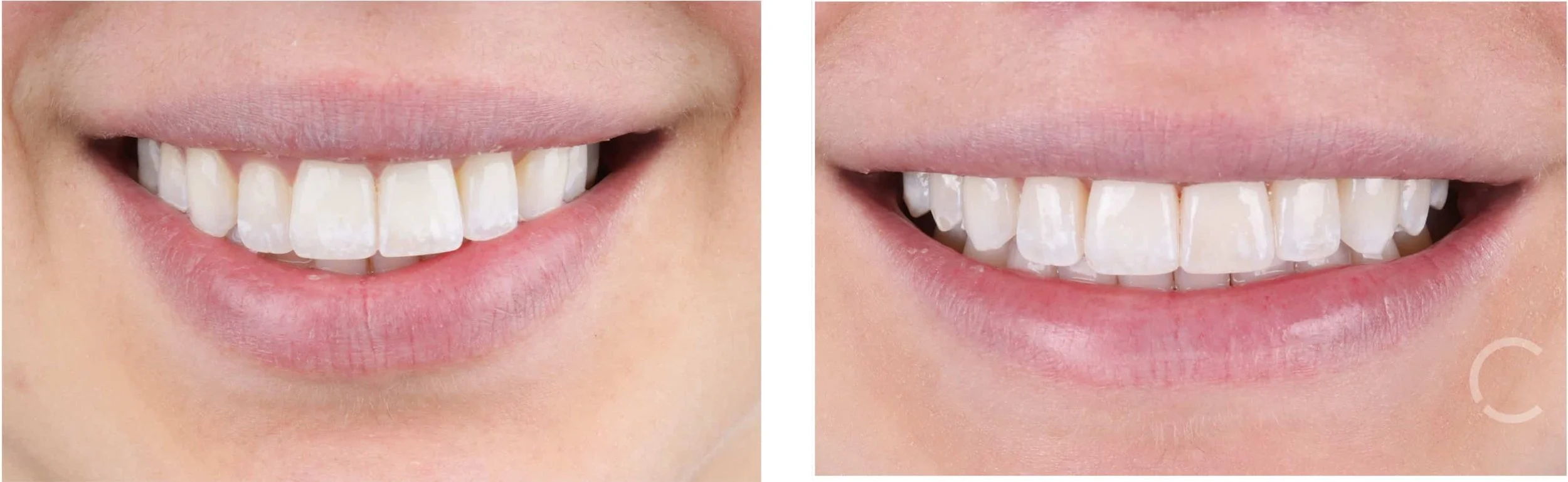
A significantly wider smile after DOMEzero treatment
Further reading
American Association of Orthodontists — What Is Mewing, and Does It Work? — https://aaoinfo.org/whats-trending/is-mewing-bad-for-you/
Angelieri F. et al. — Midpalatal Suture Maturation: A Classification Method for Individual Assessment Before Rapid Maxillary Expansion, Am J Orthod Dentofacial Orthop — https://pubmed.ncbi.nlm.nih.gov/24182592/
Midpalatal Suture Maturation in Adults Aged 16–50: A CBCT Study, BMC Oral Health 2025 — https://link.springer.com/article/10.1186/s12903-025-06883-6
Efficacy of Miniscrew-Assisted Rapid Palatal Expansion (MARPE) in Adults: A Systematic Review and Meta-Analysis, Eur J Orthod 2021 — https://academic.oup.com/ejo/article/43/3/313/6244623
Breastfeeding Duration and Malocclusions: A Systematic Review and Meta-Analysis, Sci Rep 2017 — https://www.nature.com/articles/s41598-017-05393-y
Liu S.Y. et al. — Distraction osteogenesis maxillary expansion (DOME) for adult patients with obstructive sleep apnea who have a narrow maxilla and nasal floor — https://pubmed.ncbi.nlm.nih.gov/28675100/
DOMEzero — What is DOMEzero? — https://getdomezero.com/what-is-dome-zero/