Does Mewing Work? An Orthodontist on Jaw Alignment, Results, and What Really Helps Adults
By Dr. Claudia Pinter, an orthodontist in Vienna and co-founder of DOMEzero.
You've seen it on TikTok or YouTube: Someone presses their tongue against the roof of their mouth, holds it there—and months later, their jawline looks sharper and their profile seems completely transformed.
And the idea behind it is sound: Tongue position does indeed influence how the face develops. Dentists and speech-language pathologists have known this for decades. The real question is when it takes effect—and what you can do if that window of opportunity has passed. That’s exactly what this article is about.
The short answer, if you’re short on time:
• Children: Yes—tongue position, nasal breathing, and proper chewing actually help the jaws grow wider and forward.
• Adults: Mewing alone does not change your bone structure. Skeletal expansion can widen the upper jaw and the nasal airways (see Adults: Orthopedic Expansion with DOMEzero below).
• In any case: Applying strong pressure with the tongue without guidance can unintentionally shift your teeth.
What is Mewing?
Mewing is named after the British dentist John Mew, who developed a method called “Orthotropics,” and after his son Mike Mew, who popularized it online.
The technique is simple: Place your tongue flat and wide against the roof of your mouth—the entire tongue, including the back third—keep your lips closed, let your teeth touch lightly, and breathe through your nose.
The key point is this: It should be a resting position, not an exercise. Not ten minutes a day, but all day long—until it becomes your tongue’s natural position.
Mewing Results: What Do People Hope to Achieve?
Two very different hopes:
Appearance. A more defined jawline, higher cheekbones, a midface positioned further forward, less soft tissue under the chin, and straighter teeth without braces. Online, mewing is often presented as a free, at-home alternative to facial surgery.
Health and Function. Easier breathing through the nose, less snoring, better sleep, no more dry mouth, and no more constantly stuffy nose. Some people come across Mewing while searching for answers about sleep apnea.
Both points are understandable, and both point to something real: The shape of your jaw does indeed affect your appearance and how well you breathe. The question is whether tongue positioning can achieve that.
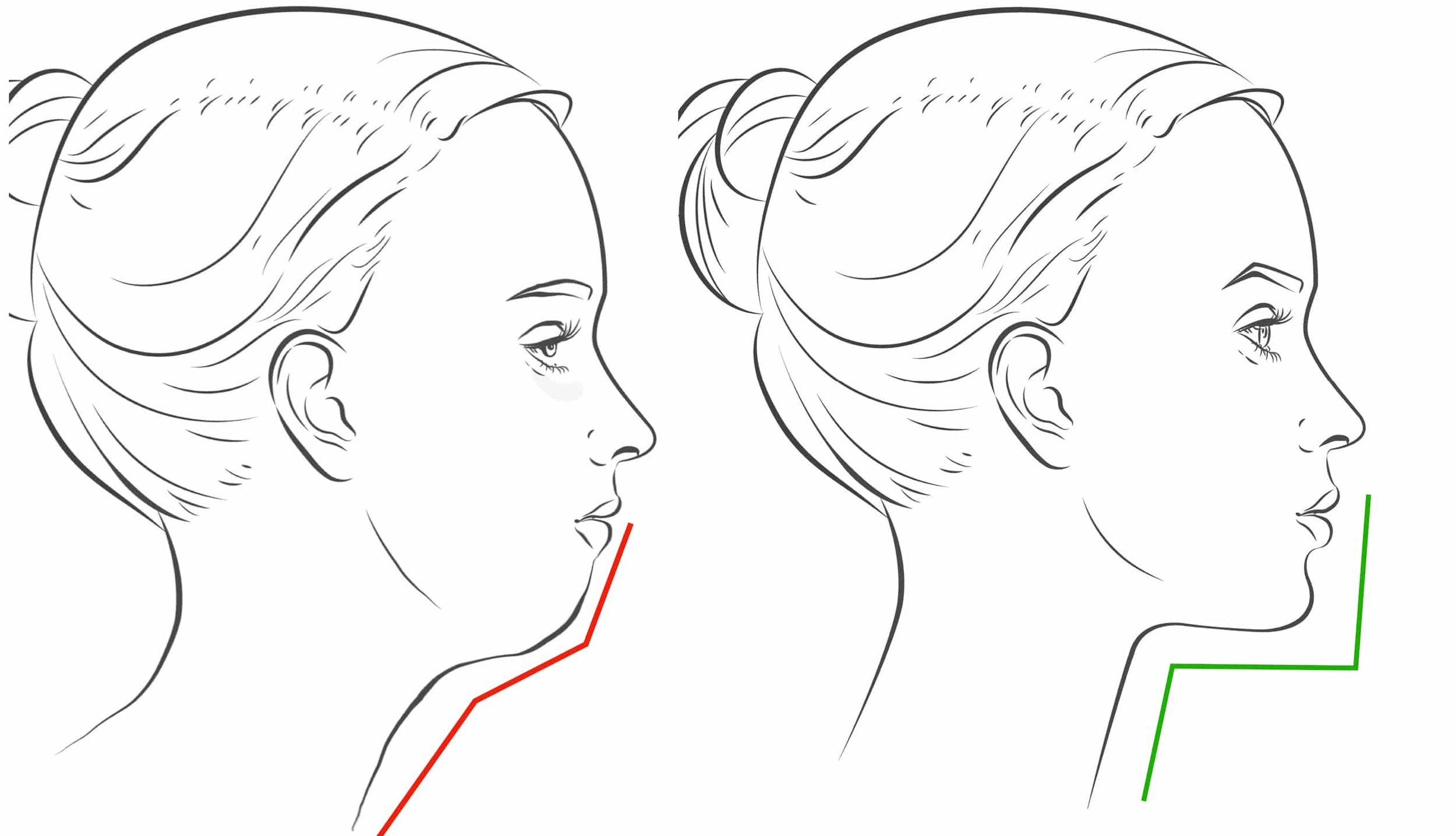
Left: Abnormal facial development resulting from mouth breathing and improper tongue position.
Right: Healthy facial development, nasal breathing, and the tongue resting against the roof of the mouth.
Mewing already had a name: myofunctional therapy
What the videos don't mention: Mewing is just one component of orofacial myofunctional therapy.
Myofunctional therapy is a targeted exercise program for the muscles of the face, mouth, and throat. This therapy focuses on:
Resting position of the tongue —at the top of the palate, not deep in the floor of the mouth
Nasal breathing —day and night, instead of habitual mouth breathing
Swallowing —without the tongue pressing forward against the teeth
Closed Lips – Lips closed at rest, without effort
Chew —properly, using your molars, on both sides
It is conducted by a trained therapist. It begins with an initial assessment, follows a personalized plan over a period of weeks to months, and determines in advance whether the conditions for success are even in place.
Does Mewing Work? Children vs. Adults
Let's split the question in two, because the answers are different.
Does the tongue play a role in how a face develops? Yes.
Can the tongue change the appearance of a fully grown face? No.
In short: In adults, Mewing does not significantly alter bone structure. The American Association of Orthodontists sums it up: The evidence supporting Mewing’s claims about jaw alignment is “as thin as dental floss.” Facial structure develops over the course of years through the interplay of genetics, bone growth, and muscle function—not from tongue position in adulthood.
What the videos rarely mention: Prolonged, uneven pressure from the tongue can shift some teeth but not others, create gaps, or cause teeth to tilt. It can alter the bite and has been linked to temporomandibular joint problems and speech difficulties. If damage occurs, the correction takes longer than the original treatment would have taken.
What Really Promotes Jaw Development
As long as a face is developing, function has a real impact. Four things matter most.
Breastfeeding. Sucking at the breast requires more effort from the tongue and jaw than bottle-feeding. Longer-term breastfeeding is associated with significantly less lateral crossbite and a lower incidence of crowded, narrow upper jaws. Limitation: These are observational studies, not proof.
Hard, fibrous food—chewed thoroughly. Bones grow under stress. Animal studies and comparisons across populations and eras suggest that soft, processed foods offer much less resistance to the growing jaw. Raw vegetables, whole fruits, hearty bread, meat on the bone: that’s exercise.
Proper resting position of the tongue. A tongue that rests against the roof of the mouth acts as a gentle internal support structure throughout the day. This is the true foundation upon which Mewing is built—in children.
Nasal breathing. This is arguably the most important factor, because it determines the others. A child who breathes through the mouth must keep it open; when the mouth is open, the tongue drops away from the palate, and the lips cannot close. Over the years, this pattern is associated with a narrow upper jaw, a longer face, and a lower jaw that is positioned lower and farther back.
All four are about function —about what the mouth must be able to do as it develops.
The principle: Form follows function
Bone is not a rigid framework. It is living tissue that remodels itself in response to the forces acting upon it—the principle behind Wolff’s Law and the reason why astronauts lose bone density and tennis players develop bone on one side of their hitting arm. In the face, this corresponds to the “functional matrix” hypothesis: the way the soft tissues function influences how the bones grow. It is a well-documented principle, not a precisely quantified law—but the general direction is clear.
A palate where the tongue rests, with calm nasal breathing, closed lips, and molars chewing real food, tends to grow wide and forward. A palate with a low-lying tongue, an open mouth, and nothing to chew tends to grow narrow and downward.
That is why myofunctional therapy has great potential in children but so little in adults. In children, you don’t force the bone in any particular direction—you change the instructions that guide its growth.
But the principle works both ways, and that’s exactly what people tend to overlook: Form also limits function. If the palate is already too narrow for the tongue, a child cannot adopt the correct posture, no matter how motivated they are. If the nose is blocked—due to adenoids, tonsils, allergies, or a deviated septum—they cannot breathe through their nose, and the mouth takes over. Every single time. That’s why you can’t just hand out exercises and hope for the best.
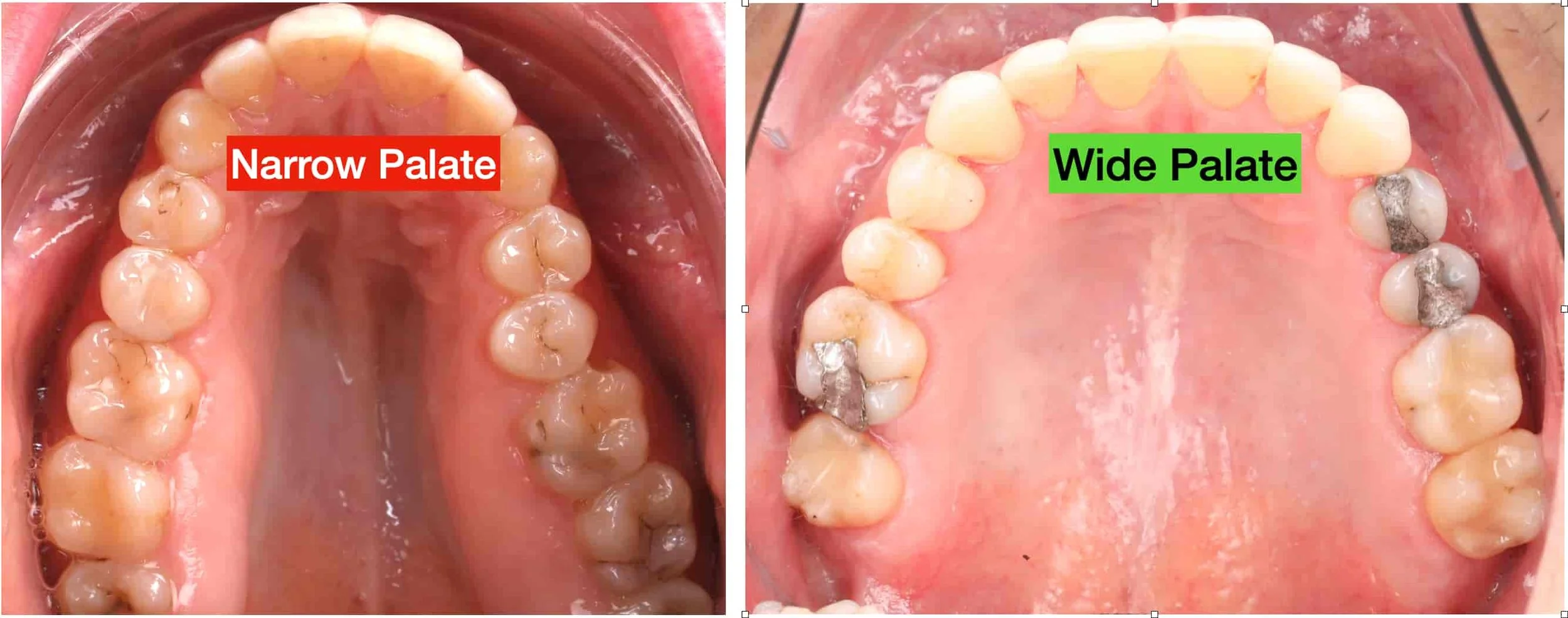
Left: narrow palate, no room for the tongue—right: wide palate with enough room for the tongue.
Is it too late? How long do the jaws keep growing?
This determines what treatment is possible—which is why it's important to be precise.
The upper jaw (maxilla): By about age 12, most of its width—and a significant portion of its overall size—has been reached; however, growth in length and height can continue into the teenage years.
The lower jaw (mandible) continues to grow—roughly until the middle or end of the teenage years for girls and until the end of the teenage years or early twenties for boys, with significant individual variations.
In short: The window of opportunity during which the jaws can be shaped through function or moved using simple appliances is childhood and early adolescence. As long as the jaws are growing, their shape can be influenced . Once growth is complete, this can no longer be achieved through function alone.
That is the real reason why Mewing doesn't work for adults. Not because the tongue isn't important—but because the tissue is no longer malleable.
What treatments are available?
Young children, ideally ages 2–6: myofunctional therapy
The best time frame ever. Establish nasal breathing, closed lips, the tongue in the correct position, proper chewing, and correct swallowing—and then let growth take its course. Early, non-invasive, working with biology rather than against it. Right at the beginning, the focus is primarily on habits and the respiratory tract (ENT and allergy treatment, weaning off pacifiers or thumb-sucking).
Two requirements, both of which are essential:
The child must be able to breathe through the nose. If the nose is blocked, the child will breathe through the mouth instead. An ENT evaluation is often the first step.
There must be room for the tongue in the mouth. If the upper jaw is too narrow, the tongue has nowhere to go.
If any of these are missing, that is addressed first.
From about age 4 through the early teenage years: Guiding growth with orthodontic appliances
If the palate is too narrow for the tongue or if the nasal airways are restricted by a narrow upper jaw, a palatal expander can widen it. Because the palatal suture is still open, this results in a genuine skeletal change rather than just tooth movement. Conventional expansion appliances anchored to the teeth become increasingly unreliable from the early to mid-teen years onward—which is precisely why the techniques for adults are described below.
The device and therapy go hand in hand here: The expansion device creates the space, and the therapy teaches the tongue to occupy and maintain that space. First form, then function.
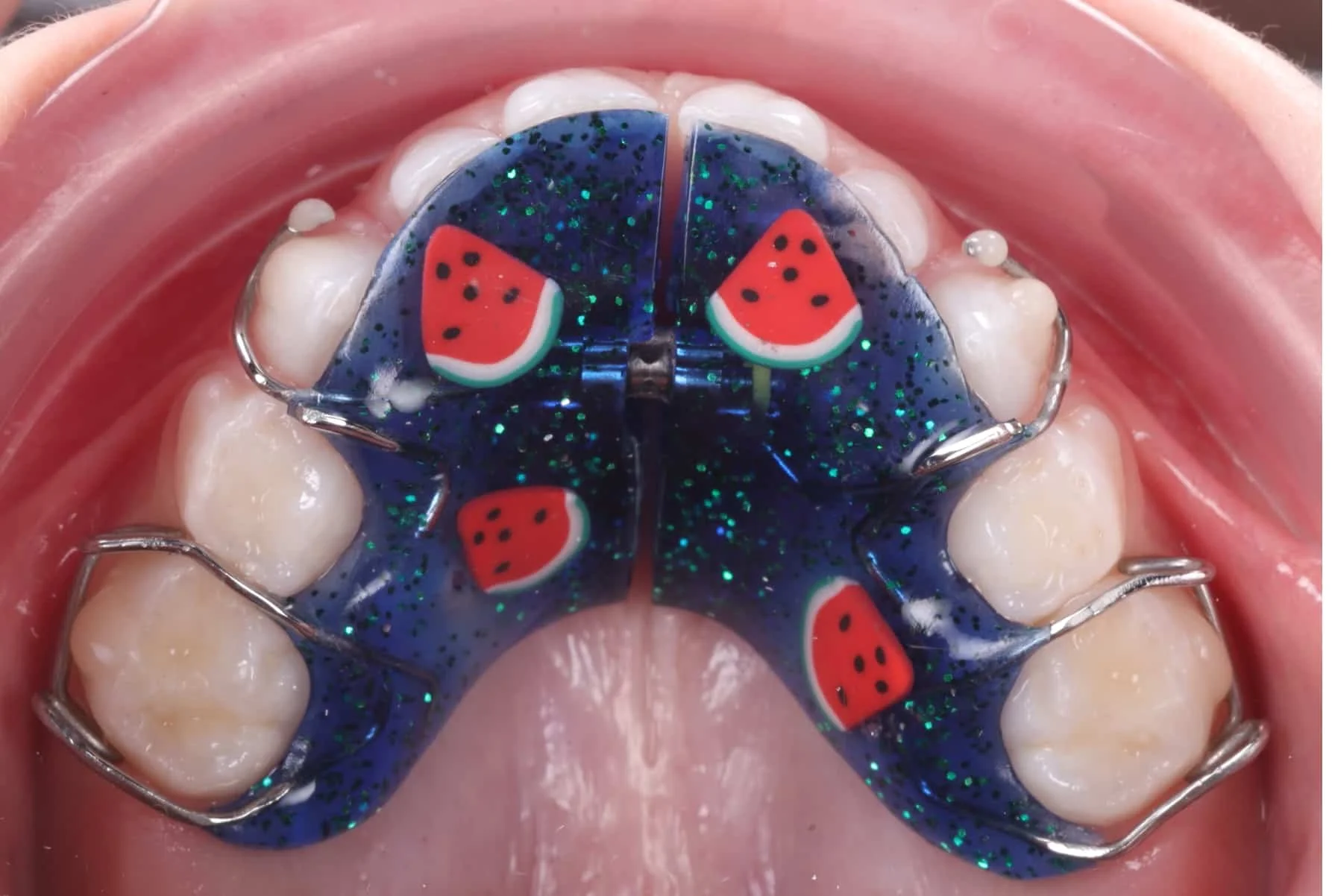
Orthodontic Appliance for a 4-Year-Old Patient
Adults: Orthopedic expansion with DOMEzero
If you're reading this, you're most likely an adult—and you'd probably prefer to have a larger jaw rather than a smaller one. A tongue position can't give you that. Skeletal expansion can.
DOME stands for Distraction Osteogenesis Maxillary Expansion; DOMEzero is the version that uses transparent aligners worn simultaneously, so that no gap opens between the front teeth. It solves exactly the problem described above: In adults, the palatal suture does not open reliably simply by applying pressure to the teeth.
So instead of simply applying pressure to the teeth and hoping for the best, the DOMEzero appliance is anchored directly into the palatal bone using mini-implants and activated gradually in small increments. The edges of the bone move apart, and the body forms new bone in the space created. (As a side note: Distraction osteogenesis is the same principle used in surgical leg lengthening.)
The “zero” refers to the gap. With conventional orthodontic treatment for adults, a wide gap forms between the upper front teeth that lasts for months. With DOMEzero, clear aligners are worn simultaneously and guide the teeth into the newly formed bone—so the gap never opens in the first place.
What may change:
A wider palate —real room for the tongue
A wider nasal floor and larger nasal airways —easier nasal breathing and, for many patients, better sleep and less snoring
A wider dental arch when smiling —a structural change in the upper jaw, not a cosmetic illusion
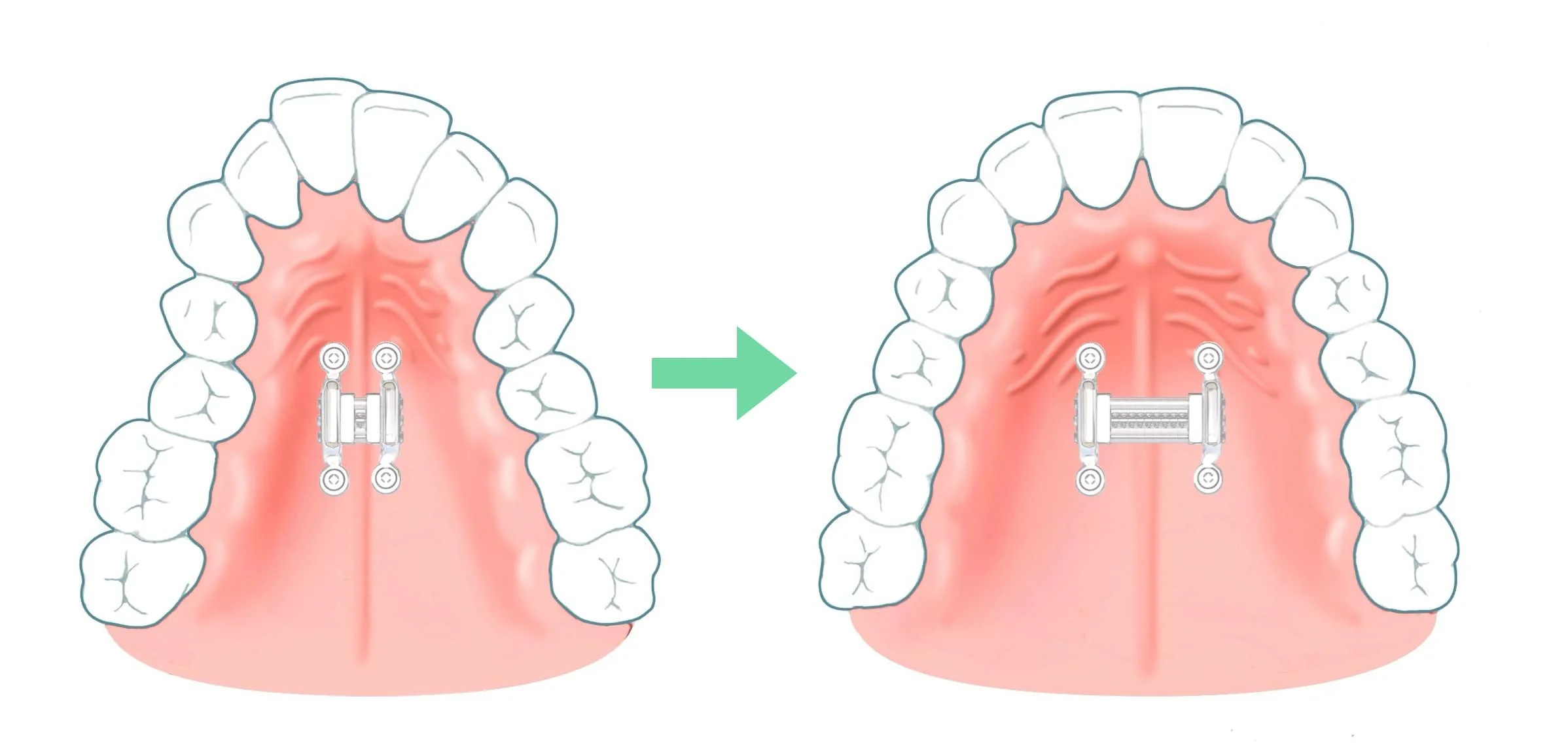
DOMEzero illustration: Jaw expansion in adults
What else you should know. DOMEzero is designed to avoid bone cuts whenever possible, and for most adults, this is successful—but sometimes the bone resists separation, and a (minimally invasive) surgical procedure is necessary. This cannot always be predicted based on imaging.
If snoring or daytime sleepiness is the reason for your interest, you’ll need a sleep study and a medical diagnosis. Airway dilation can significantly improve breathing, and the published data comes from adults diagnosed with obstructive sleep apnea. However, it is not a cure in and of itself and should not be started based on mere suspicion.
Treatment Schedule (this is our approach; other practices may plan differently). The active expansion phase usually lasts 4–8 months—deliberately slow, because the aligner movement is tailored to this process. Afterward, the appliance remains in place for another 9–12 months while the new bone mineralizes. Including fine-tuning of the bite, treatment takes about two years on average. This is true orthopedic treatment, not a quick fix—but it reshapes the skeleton, and nothing else described here can do that for adults.
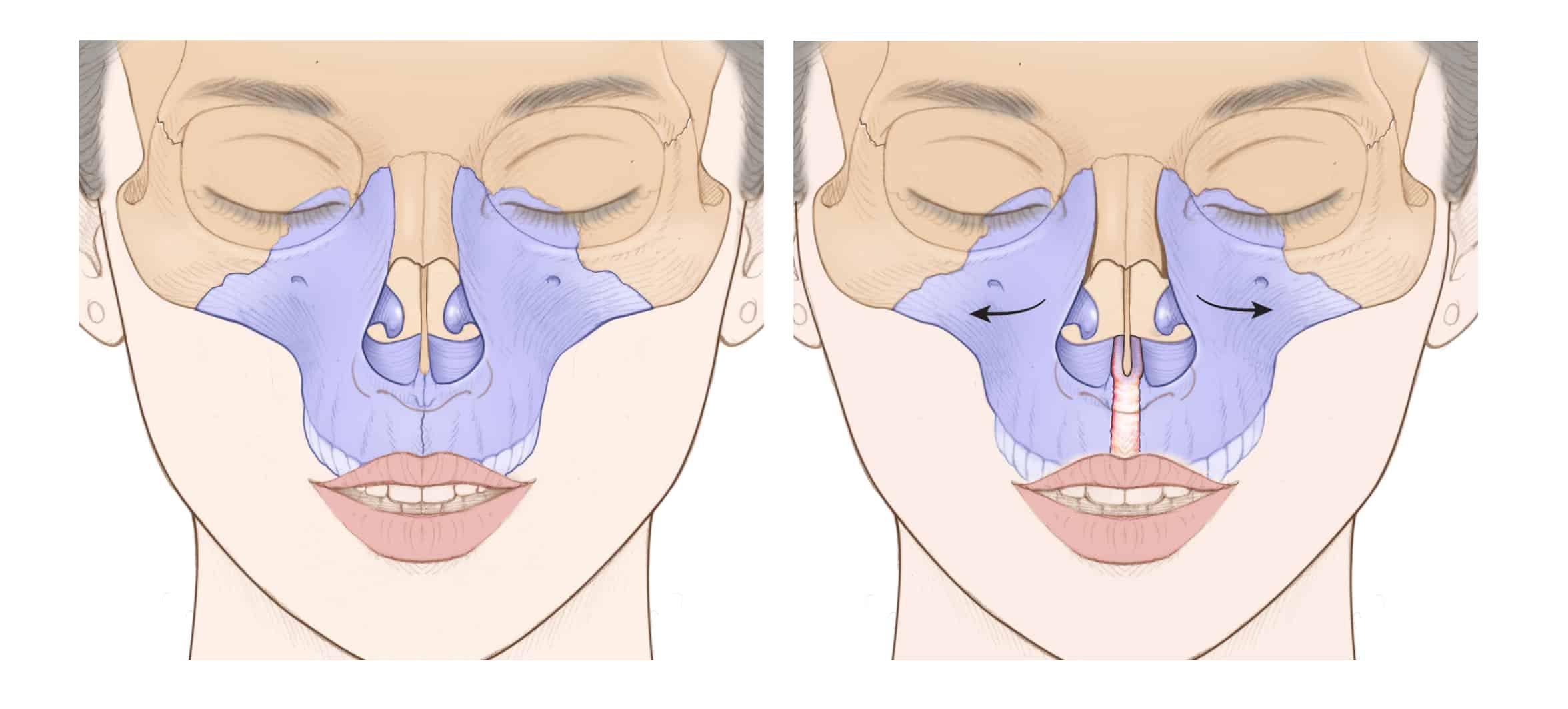
Effect of DOMEzero on the nasal cavity (wider nasal floor) and the smile (wider smile).
And then the function must follow
With DOMEzero, we've created the right form. Now it's time to focus on function.
That is why I strongly recommend that adults who have undergone a palatal expansion also work with a myofunctional therapist. This therapy retrains the resting position, establishes nasal breathing and lip closure, and corrects swallowing patterns. This training helps ensure the stability of the results, rather than allowing them to regress.
The entire message of this article in two sentences: In children, function shapes form. In adults, we create the form—and function sustains it.
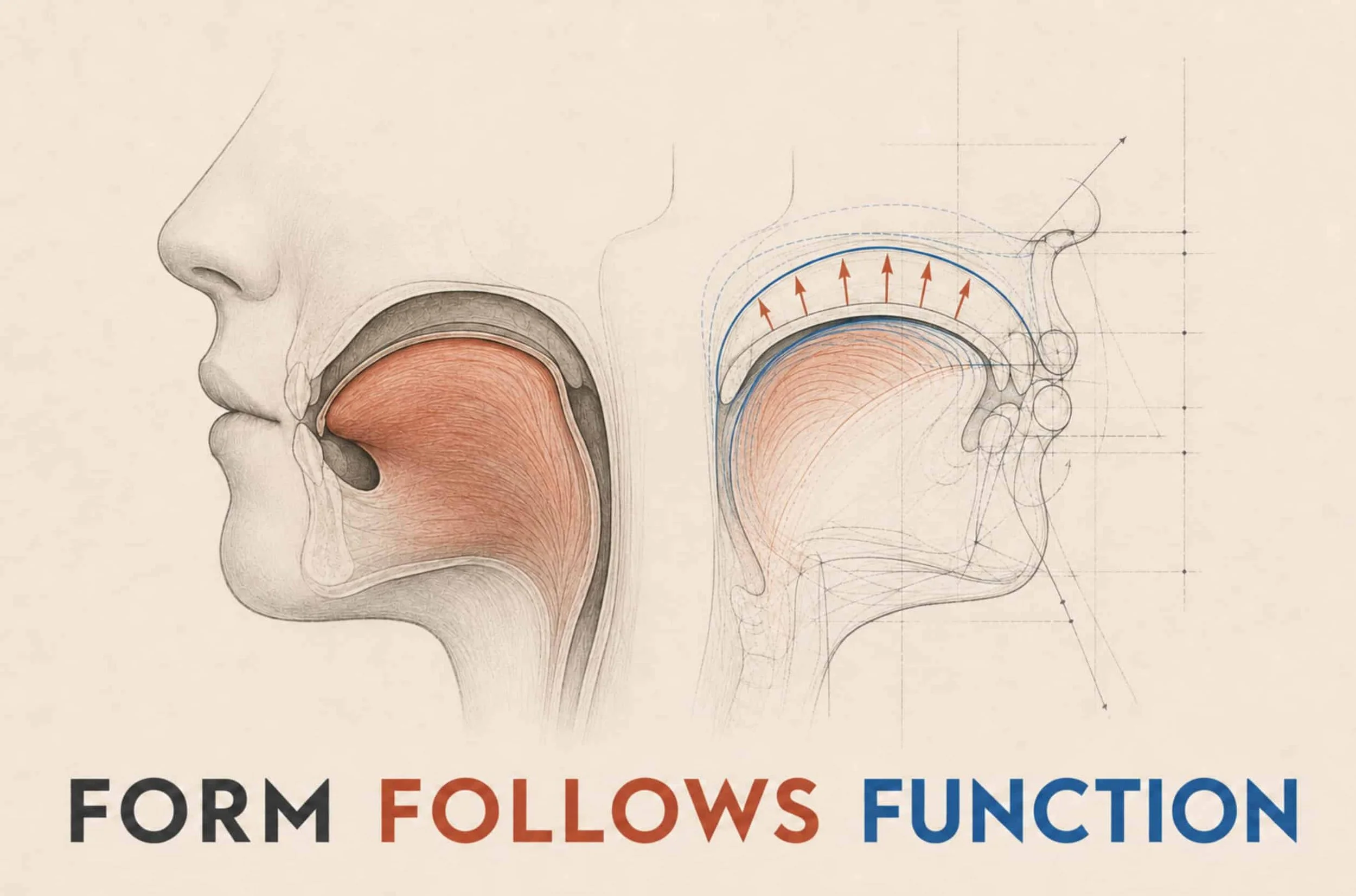
During the first few years of life, the tongue shapes the palate.
So does Mewing really work?
As a quick fix for your jawline: no. Once your face has fully developed, pressure from your tongue won't change your bone structure—and without proper guidance, you risk unintentionally shifting your teeth.
As a rediscovery of the truth about how faces develop: absolutely. Tongue position, nasal breathing, and proper chewing are incredibly important—during growth. The problem with Mewing isn’t the idea itself. It’s the timing.
If you recognize yourself in this description as an adult—a narrow palate, crowded teeth, no room for your tongue, a nose that’s never really clear, snoring, waking up feeling tired—then the sensible next step isn’t another tongue exercise, but finding out whether your upper jaw can still be widened and what that would mean for you.
That’s exactly what an initial consultation is for. We’ll examine your airways, your palate, your bite, and the imaging results, and give you a clear answer as to whether DOMEzero is right for you—including what it can’t change and whether something else might be a better fit for you.
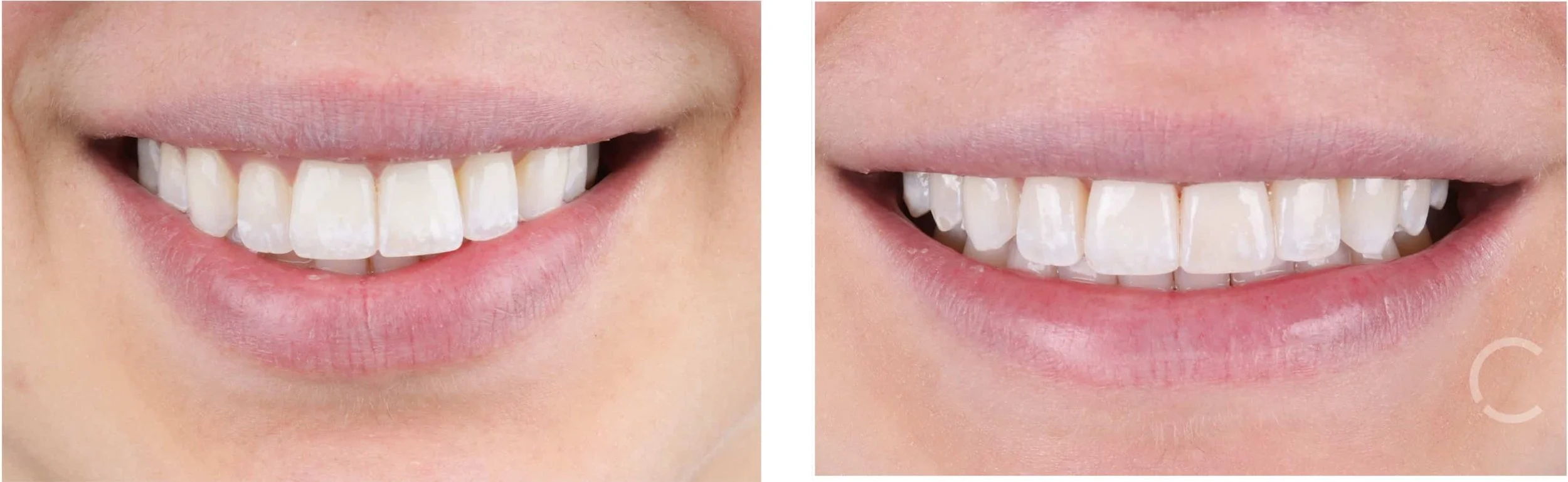
A Noticeably Wider Smile After DOMEzero Treatment
Frequently Asked Questions About Mewing
How long does it take for Mewing to show results?
In adults, Mewing does not alter bone structure, no matter how long you do it. What many “Mewing before-and-after” photos show is usually a change in head posture, different lighting, a different camera angle, or a change in body weight. In growing children, myofunctional therapy takes effect over a period of months to years—and only if the child breathes through the nose and has enough space in the palate.
Is Mewing bad for your teeth?
A relaxed, natural resting position for the tongue is healthy. Pressing the tongue strongly for hours on end without proper guidance can shift individual teeth, create gaps, or alter the bite, and has been linked to temporomandibular joint disorders.
Is it still possible to widen the upper jaw as an adult?
Yes—but not with the tongue. A skeletal expansion device anchored to the palatine bone, such as DOMEzero or MARPE, can widen the upper jaw and the floor of the nose in adults.
Mewing or myofunctional therapy—what's the difference?
Mewing is a single component: tongue positioning. Myofunctional therapy is a structured program led by a trained therapist that also addresses nasal breathing, swallowing, lip closure, and chewing—and first assesses whether the prerequisites are met.
Should my child try Mewing?
Don't rely solely on a video. First, have a professional assess your child's nasal breathing and the width of the palate. If both are normal, a myofunctional therapist can guide the exercises—at the age when they are most effective.
Further Reading
American Association of Orthodontists — What Is Mewing, and Does It Work? — https://aaoinfo.org/whats-trending/is-mewing-bad-for-you/
Angelieri F. et al. — Midpalatal Suture Maturation: A Classification Method for Individual Assessment Before Rapid Maxillary Expansion, Am J Orthod Dentofacial Orthop — https://pubmed.ncbi.nlm.nih.gov/24182592/
Midpalatal Suture Maturation in Adults Aged 16–50: A CBCT Study, BMC Oral Health 2025 — https://link.springer.com/article/10.1186/s12903-025-06883-6
Efficacy of Miniscrew-Assisted Rapid Palatal Expansion (MARPE) in Adults: A Systematic Review and Meta-Analysis, Eur J Orthod 2021 — https://academic.oup.com/ejo/article/43/3/313/6244623
Breastfeeding Duration and Malocclusions: A Systematic Review and Meta-Analysis, Sci Rep 2017 — https://www.nature.com/articles/s41598-017-05393-y
Liu S.Y. et al. — Distraction osteogenesis maxillary expansion (DOME) for adult patients with obstructive sleep apnea who have a narrow maxilla and nasal floor — https://pubmed.ncbi.nlm.nih.gov/28675100/
DOMEzero — What is DOMEzero? — https://getdomezero.com/what-is-dome-zero/