Jaw joint clicking – harmless or a warning sign?
A clicking sound in the jaw joint – when yawning or chewing – often seems harmless, but it is a sign that something in the chewing system is out of balance. Even if it is not yet painful, it should be taken seriously – because if left untreated, it can lead to permanent damage to the joint, muscles, and teeth.

What Happens When the Jaw Clicks?
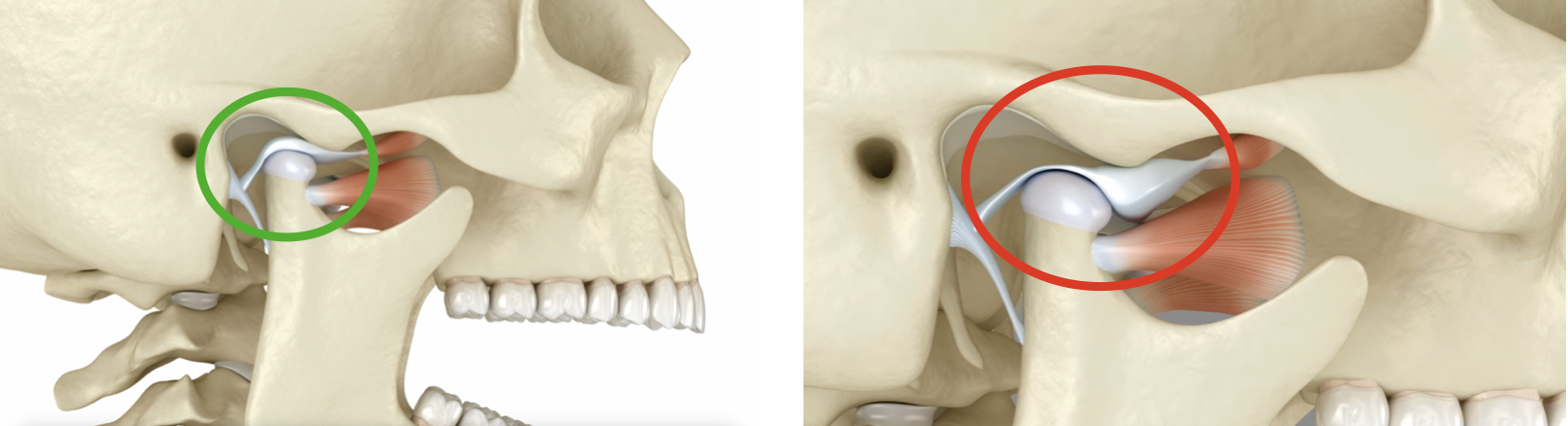
The jaw joint functions like a finely tuned mechanism. The condyle (the 'head' of the lower jaw) moves on a small connective tissue disc – the meniscus – when opening and closing.
This disc ensures that the movement is smooth and pain-free – much like a sled gliding on a track.
If clicking occurs, it indicates that the condyle is no longer ideally positioned on the disc. For example, it might have slipped backward and then abruptly snaps back onto the meniscus when the mouth opens – this is the typical 'clicking' sound.
Possible Causes of Clicking
The reasons for this can vary greatly. Here are some common triggers:
Teeth Grinding or Clenching: Constant pressure pushes the condyle backward and upward, causing it to slip off the meniscus.
Overly Narrow Upper Jaw: Forces the lower jaw backward, similar to a foot in a shoe that is too small – preventing proper forward movement.
Incorrect Bite: If the teeth do not meet harmoniously, the lower jaw often has to shift sideways – which can sometimes be recognized by a slightly asymmetrical chin position.
Persistent Misalignment/Strain: The chewing system tries to 'protect' itself, which can lead to muscle tension and pain – comparable to the unconscious gait one adopts when having a blister on the foot.
How Can This Be Treated?
The good news is that jaw joint problems are usually treatable. It is crucial to identify the individual cause – because every solution must be custom-tailored.
Bite splints often help as a first step: They relieve pressure on the joint, indicate whether tooth contacts are the problem, and guide the joint back into a healthy position.
Long-term Therapy: The goal is to achieve this physiological state even without a splint – through:
Bite Adjustment
Harmonization of Jaw Position
In some cases, orthodontic measures as well
My Approach
I take the time to truly understand the causes and interconnections of your individual case to find the right therapy for you. Only when the chewing system is back in balance can it function pain-free and stably in the long term.